
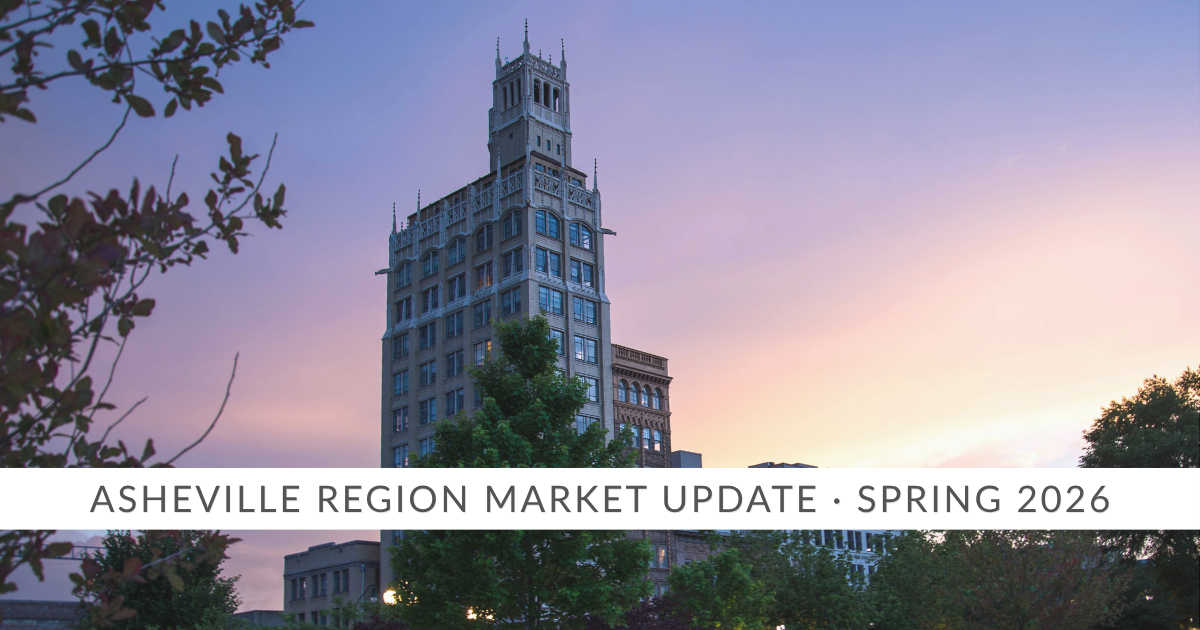
The Asheville region’s real estate market has shifted, and if you’re buying or selling a home in 2026, that shift matters. After years of limited inventory, bidding wars, and homes flying off the market in days (or even hours), the market has found a new rhythm. For buyers, that means more options and less urgency than the market has offered in recent years. For sellers, it means that accurate pricing and thoughtful presentation matter more than they have at any point since before the pandemic.
Asheville Real Estate Q1 2026 Stats at a Glance
- Median Sales Price: $410,000 (0.0% year-over-year)
- Average Sales Price: $534,321 (+6.4% YOY)
- Percent of Original Sales Price Received: 91.8% (-2.2% YOY)
- Inventory of Homes: 3,826 (+13.3% YOY)
- Closed Sales: 1,947 (-2.7% YOY)
- Months Supply: 4.6 (+5.0% YOY)
- List to Close: 136 days (+14.5% YOY)
- Days on Market: 91 (+30.7% YOY)
What Sellers Need to Know in Asheville Right Now
Patience is key, and first impressions are everything. We encourage our sellers to complete as many small home refreshes as possible, such as a fresh coat of paint in the kitchen or a new layer of mulch in the garden before photos are taken. Buyers are forming opinions before they even schedule a showing.
Buyers are taking longer to make decisions, and this is directly reflected in the days on market, which saw a 30.7% increase year-over-year to 91 days. With homes staying on the market longer, it may feel like sellers are facing more competition than usual. In reality, while the number of homes on the market has increased slightly (13.3%) since last year, Q1 2025 saw an even more aggressive 41.5% YOY increase in inventory — an uptick that can likely be attributed to both the immediate and long-term effects of Hurricane Helene.
Offering incentives such as credits for interest rate buydowns can help on-the-fence buyers make a move. Getting a pre-listing home inspection also helps buyers feel more confident that they are purchasing a solid home and leads to fewer surprises when buyers conduct their own inspection. In short, we encourage a unique and thorough presentation to capture the attention of as many buyers as possible.
What Buyers Need to Know in Asheville Right Now
Time and time again, we hear that interest rates and a lack of affordable inventory are what hold buyers back. The median sales price remaining unchanged at $410,000 is a promising sign that the market remains healthy and active under $400,000. Interest rates have also dropped into the 5–6% range after years above 7%, creating more opportunities for first-time and low-income buyers to enter the market.
Many sellers are still holding onto COVID-era mortgage rates, so negotiations may be more challenging, as sellers must contend with purchasing a home in today's 2026 market. Price reductions and lower offers are no longer unexpected — the percentage of original sales price received decreased 2.2% YOY to 91.8% — and there is more room for negotiation between buyer and seller. Even so, we have seen multiple-offer situations and buyers offering above asking price when the home is in great condition, in the right spot, and at the right price.
Will prices fall so far it feels like 2008 all over again? We consulted the Magic 8-Ball, and it said "Try Again Later." While we have our quirks, Asheville remains a beautiful city to call home. Buncombe County and the surrounding counties continue to grow and attract residents from all over, drawn by mountain views, proximity to nature, restaurants, breweries, lifestyle, and more.
What is Considered the Asheville Region?
This data comes from Canopy MLS (Multiple Listing Service) and encompasses Buncombe, Burke, Haywood, Henderson, Jackson, Madison, McDowell, Mitchell, Polk, Rutherford, Swain, Transylvania, and Yancey counties as well as cities including Asheville, Arden, Fletcher, Black Mountain, Hendersonville, and Weaverville. It includes single-family homes, townhomes, and condominiums combined. Data is refreshed and updated regularly in the MLS, and this data is accurate as of May 5th, 2026.
Our data can be broken down by specific zip code within each county. Want to know what your Asheville home is worth in today’s market or where the best buying opportunities are? Contact HomeSource Realty for a personalized local market strategy. Reach out to our team of real estate professionals by phone at 828-252-1023 or by email at [email protected].
Are home prices dropping in Asheville in 2026?
Median prices stayed flat in Q1 2026, showing stabilization rather than a major decline. A crash is unlikely though. Strong homeowner equity and strict lending standards are preventing most potential distressed sales. The market is rebalancing, not collapsing.
Is now a good time to buy a home in Asheville?
After a frenzied seller’s market over the past few years, 2026 is presenting a meaningful window of opportunity. Homes are sitting on the market longer and the vast majority of listings have seen price reductions, giving buyers more options and negotiating leverage. On the rate side, the national 30-year conventional mortgage rate has been averaging around 6.3%. While not as favorable as the historic lows of 2020-2021, rates have stabilized enough that buyers who find the right home now are able to make a move. Waiting for the perfect moment - lower prices, lower rates, and more inventory - is unlikely to pay off.
How long do homes take to sell in Asheville?
Homes averaged 91 days on market in Q1 2026, more than double the average from a year prior. List to close averaged 136 days, meaning sellers and buyers are working together on more flexible timelines. Accurate pricing from day one is the single biggest factor in how quickly a home moves in today's Asheville market.
Is Asheville still growing in 2026?
Yes, although the pace has moderated somewhat. The Asheville metro area population was approximately 381,000 in 2025, growing approximately 1.33% annually, a rate it has maintained consistently over the past several years. The beauty of the mountains, diverse economy, and lifestyle appeal of Western North Carolina continue attracting new residents both near and far away. This demand continues to support a robust real estate market even as inventory rises and days on market lengthen.
Check out this article next